

In the vast expanse of cinematic history, few films have managed to evoke the same level of revulsion, discomfort, and fascination as Tom Six's 2009 psychological horror film, "The Human Centipede." This Dutch-Italian production has become a cult classic, sparking both admiration and condemnation from audiences worldwide. For those unfamiliar, the film's premise is as follows: two American tourists, Lindsay (Ashley C. Williams) and Jenny (Ashley D. Milligan), find themselves kidnapped by the deranged German surgeon, Heiter (Dieter Laser), who has a twisted dream of creating a human centipede – a grotesque conjoined triplets formation.
Despite (or because of) its notorious reputation, "The Human Centipede" has become a cult classic, inspiring a devoted following of fans who appreciate its transgressive power and challenging themes. The film's success also spawned two sequels, "The Human Centipede 2 (Full Sequence)" (2011) and "The Human Centipede 3 (Final Sequence)" (2015), which continued to explore the twisted world of Heiter's creations.
The film's existence is a testament to the enduring power of transgressive cinema, which continues to push the boundaries of what is considered acceptable on screen. "The Human Centipede" is not for the faint of heart; it's an unflinching exploration of the darkest recesses of human psychology, an inquiry into the nature of suffering, and the capacity for cruelty that lies within us all. human centipede soap2day
In conclusion, "The Human Centipede" is a complex and challenging film that defies easy categorization. It is a work of art that inspires both fascination and revulsion, often simultaneously. As a cultural artifact, it serves as a mirror to our own darker impulses, forcing us to confront the depths of human cruelty and the darkness that lies within.
The idea for "The Human Centipede" was born from a conversation between Tom Six and his friend, Marius Stan, who joked about a surgeon creating a human centipede. Six was immediately captivated by the concept, seeing its potential as a metaphor for the fragmentation of human identity and the reduction of individuals to mere objects. Heiter's horrific creation serves as a twisted reflection of our own fears about bodily autonomy, the blurring of lines between self and other, and the primal anxiety of being consumed by forces beyond our control. In the vast expanse of cinematic history, few
Detractors argued that the film's explicit content served no artistic purpose, instead catering to a prurient audience seeking vicarious thrills. Conversely, supporters of the film countered that its unflinching portrayal of violence and suffering served as a form of social commentary, highlighting the darker aspects of human nature.
Beneath its grotesque surface, "The Human Centipede" conceals a scathing critique of modern society. The film serves as a commentary on our culture's voyeuristic tendencies, as embodied by Heiter's obsessive fascination with his victims. His actions are a twisted manifestation of our own desires to gaze upon and consume the suffering of others, often under the guise of entertainment. Milligan), find themselves kidnapped by the deranged German
Can films like "The Human Centipede" serve as a form of social commentary, or do they merely cater to our baser instincts? Is there a place for such challenging content in our increasingly sanitized and sterilized media landscape?


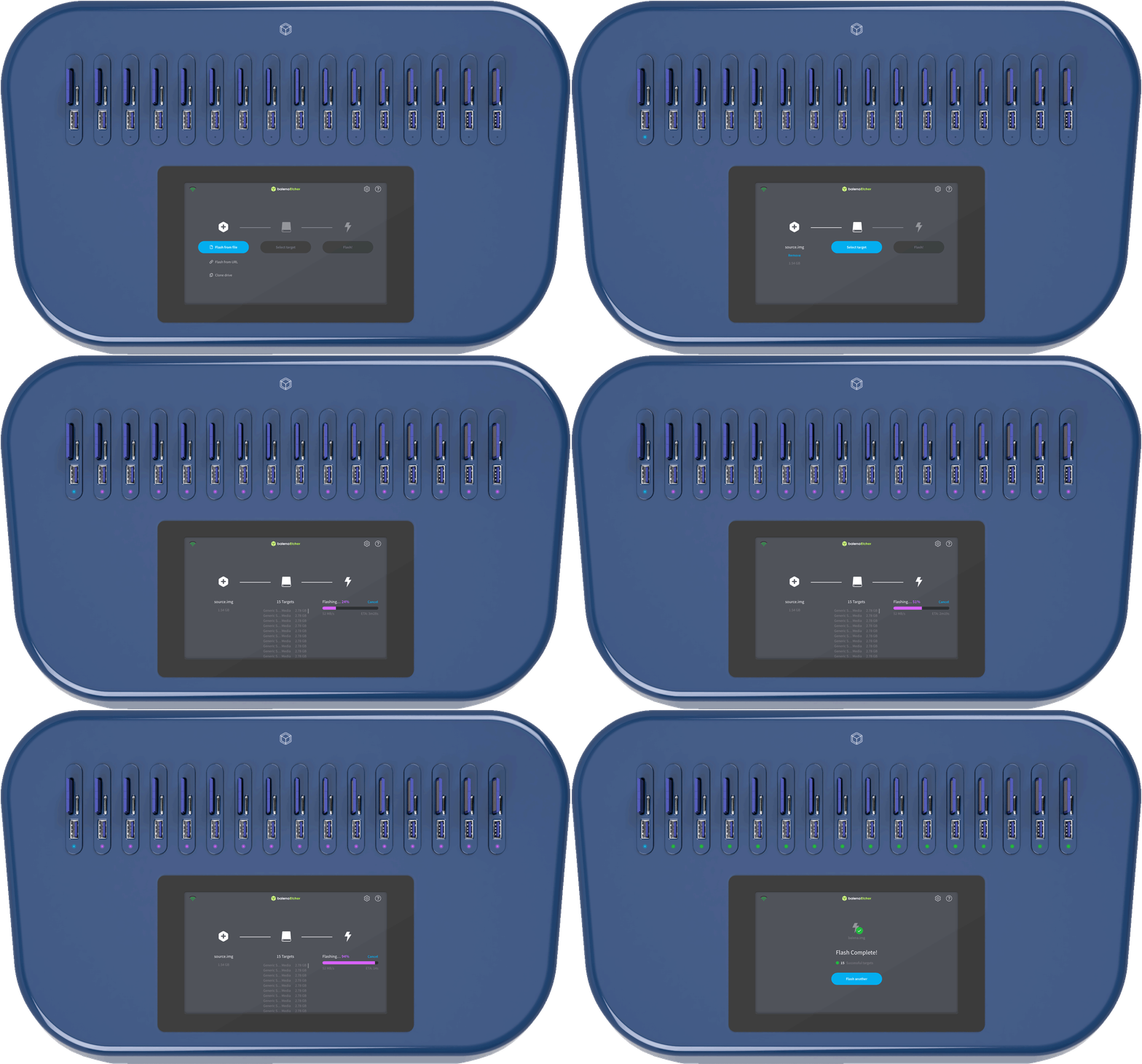
Every EtcherPro can flash up to 16 drives at a time if you are flashing from an online source. If you are flashing from a physical drive, you would be flashing up to 15 drives at a time, as the first slot would serve as the source. In the daisy-chaining scenario, you would only require one slot to serve as a source to flash the entire stack, when flashing from a physical drive.
EtcherPro offers USB (type A), SD and microSD interfaces by default, so you can flash up to 16 different drives / devices simultaneously. For instance, you can flash a balenaFin, a USB drive, an SD card and a microSD at the same time, as long as there is only one target per slot, and the source being flashed is the same for all target types.
EtcherPro supports USB (type A), SD and microSD interfaces, and can also flash single-board computers that are capable of being flashed via USB, as long as they are supported by Etcher. You can flash compute modules through carrier boards, for instance, flashing a Raspberry Pi CM3 through a balenaFin.
EtcherPro runs our open-source data-flashing software, Etcher, which can flash any kind of data. If you want to make sure that Etcher is capable of flashing your drive / device, you can download the latest version of Etcher and test it on your system to ensure compatibility.
When writing 16 drives simultaneously, EtcherPro can write up to 52 MB/s per drive, while when writing just 1 drive, EtcherPro can reach up to 200MB/s, so long as the drive / device can support those flashing speeds.
Etcher has a feature known as ‘trimming’ which can potentially accelerate the flashing of certain images by avoiding writing unused parts of ext partitions. As a result, you effectively get a bonus on the flashing speed.
EtcherPro flashes all target drives simultaneously, as such, the speed is determined by the drive that writes slowest. If you flash 1 drive that writes slowly, and 15 fast ones, the slow drive will determine the overall write speed. To account for this, make sure that all the drives, including the source drive (if any), can write at least as fast as EtcherPro flashes (52MB/s for 16 drives). Oftentimes, the advertised speed for a drive is the reading speed, rather than the writing speed (which is much slower). If you are sure your setup is up to spec and you still have issues please contact us.


.webp)